

You pull a double shift, or you stay late three nights in a row, thinking you’re finally going to see a bigger number on your paycheck. Then payday shows up, and… it’s not what you expected. If you’ve ever stared at your pay stub and asked yourself, “why is my overtime taxed so much?” – you’re definitely not alone. This happens to hourly workers all over the country, every single pay period.
Here’s the good news: your overtime isn’t actually being punished by some special overtime tax. What’s really going on is a little more boring than that – but once you understand how overtime gets taxed, it stops feeling so confusing (and honestly, a little unfair).
Is Overtime Really Taxed Higher Than Regular Pay?
Let’s clear this up right away, because it’s the biggest myth out there: no, overtime is not taxed at a higher rate than your regular pay. There’s no line in the tax code that says “overtime hours get taxed more.” That rule simply doesn’t exist.
Every dollar you earn whether it came from your normal 9-to-5 hours or from staying late on a Friday gets lumped together as one number: your total taxable income. The IRS doesn’t look at your pay stub and separate “regular dollars” from “overtime dollars.” It’s all just income to them, taxed the exact same way.
Update: Under the recent tax reform, you might be eligible to completely eliminate federal income tax on your extra hours. Find out when does no tax on overtime start and how the new OBBBA limits work.
So if the overtime tax rate isn’t actually higher, why does your check look smaller than it should? That’s where things get interesting and it’s really about how your paycheck is calculated in that moment, not about you owing more money.
So Why Does It Feel Like You’re Losing More Money?
This is the part almost nobody explains well. Your employer’s payroll software has to guess how much tax to hold back from every paycheck. And it does that guessing using a method that isn’t exactly fair to overtime workers even though it evens out later.
- Your payroll system sees this week’s paycheck and treats it like it’s your normal, every-week amount.
- If this check is bigger because of overtime, the system assumes you’ll earn that much every week for the rest of the year.
- Based on that wrong assumption, it withholds tax like you’re a higher earner even though you’re not.
- On top of that, FICA (that’s Social Security and Medicare combined) takes its flat cut from every extra dollar too, no exceptions.
So basically, your employer isn’t taxing your overtime pay more on purpose. Their system is just over-estimating how much overtime tax to pull, because it doesn’t know this is a one-time bump and not your new normal income.
How Tax Brackets Actually Work (Simple Breakdown)
A lot of people believe that earning more money bumps their entire paycheck into a higher tax bracket. That’s just not how it works, and it’s honestly one of the most common misunderstandings about how income tax gets calculated.
The U.S. uses what’s called a progressive tax system. That basically means only the chunk of money that falls inside a certain range gets taxed at that range’s rate. To help you understand how your overtime spills over, here are the official federal tax brackets for single filers:
| Income Range | Tax Rate |
| $0 – $12,400 | 10% |
| $12,401 – $50,400 | 12% |
| $50,401 – $105,700 | 22% |
| $105,701 – $201,775 | 24% |
So even if your overtime pushes a little bit of your income into a higher bracket, only that small slice gets taxed at the higher rate — not your whole paycheck, and definitely not your regular hours.
A Real-Life Example: Regular Week vs. Overtime Week
Numbers usually make this click faster than explanations do, so let’s walk through a simple, everyday example.
Say you normally earn $24.00 an hour, and you work a standard 40-hour week. Your usual weekly gross pay is $960.00 (which aligns with the 12% tax bracket annually).
This week, you picked up heavy overtime and worked 55 hours total (15 hours of overtime).
- Regular pay: 40 hrs × $24.00 = $960.00
- Overtime rate (time-and-a-half): $24.00 × 1.5 = $36.00/hr
- Overtime pay: 15 hrs × $36.00 = $540.00
- Total gross pay for the week: $960.00 + $540.00 = $1,500.00
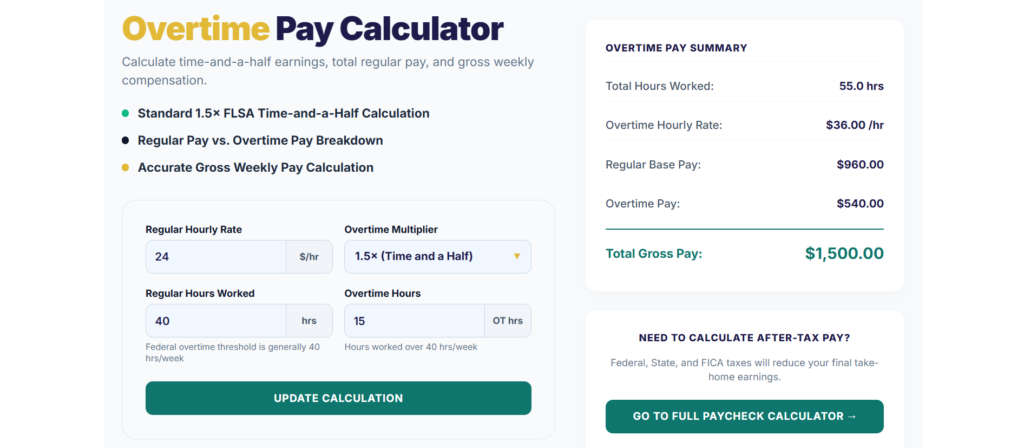
You can easily check your exact overtime earnings and tax breakdown using our free Overtime Pay Calculator
Here is where the magic (and confusion) happens:
If you made $1,500 every single week, your annual income would be $78,000. On paper, that annual amount pushes you out of the 12% bracket and straight into the 22% tax bracket!
Because your payroll software handles taxes week-by-week, it assumes you are now a higher earner making $78,000 a year. It immediately starts withholding taxes at that higher 22% rate for your extra earnings. That mismatch is exactly why your overtime pay after taxes looks smaller than it feels like it should.
Will You Get That Extra Withheld Money Back?
In most cases, yes and this is honestly the part that gives people the most relief once they understand it. Whatever gets withheld from your paycheck throughout the year is just an estimate. It’s not your final tax bill.
- When tax season comes around, the IRS looks at your real total income for the whole year not just that one heavy overtime week.
- If too much was withheld because of your overtime checks, you’ll usually get that difference back as a refund.
- If too little was withheld (which is rare with overtime specifically), you might owe a small amount instead.
So that money isn’t gone forever. It’s more like the government is holding onto a bit extra of your cash for a few months, and then handing it back once everything gets sorted out on your tax return.
A Few Quick Tips If Overtime Tax Confuses You Every Payday
If this whole overtime taxed situation keeps catching you off guard, here are a few small things that actually help:
- Check your W-4 with your employer adjusting your withholding preferences can smooth out how much gets pulled from each check.
- Don’t panic over one small paycheck look at your total pay over the whole month or year instead.
- Use a paycheck calculator before tax season so you’re not surprised by your take-home pay after taxes.
- Keep a rough note of your overtime hours so you can compare them against your pay stub if something looks off.
Want to see the actual math behind your paycheck? Check out our step-by-step breakdown on how is overtime taxed to calculate your net earnings.
Quick Recap
- Overtime taxed at a higher rate is a myth it’s taxed exactly like your regular income
- Your check feels smaller because of how withholding gets calculated for that one pay period, not because of extra tax
- Only the portion of income above a bracket threshold is taxed at a higher rate never your whole paycheck
- Over-withheld tax from your overtime pay usually comes back to you when you file your yearly tax return
FAQs
Is overtime taxed at 50%?
No, and this is one of the most common things people get wrong. There’s no rule anywhere that taxes overtime at 50% or any other fixed rate. It’s taxed the exact same way as your regular wages, based on your total income for the year not on the fact that it’s labeled “overtime.”
Why does my overtime pay feel like it just disappears into taxes?
This happens because your employer’s payroll system treats a bigger paycheck as if you’ll earn that same amount every week going forward. So it withholds tax based on that assumption, which pulls out more money upfront than what you’ll actually end up owing once tax season rolls around.
Can I do anything to reduce the tax withheld from my overtime?
You can update your W-4 withholding preferences with your employer, and that can smooth things out a bit. But keep in mind your total tax liability for the year stays exactly the same no matter how withholding is adjusted. You’re just changing when the money gets held back, not how much you ultimately owe.
Does working overtime permanently push me into a higher tax bracket?
No, not at all. Tax brackets are based on your total annual income, not on one single paycheck. Even if some of your overtime income lands in a higher bracket, only that specific portion gets taxed at the higher rate everything else stays right where it was.
Is overtime taxed differently depending on the state I live in?
Federal tax rules stay the same no matter where you live, but state income tax rates and withholding rules can be very different from state to state. Some states don’t even have a state income tax at all, which can noticeably change how much gets withheld from your overtime paycheck.
How much tax is actually taken out of overtime pay?
There’s no single fixed number, because it depends on your total income, your filing status, and which state you live in. The important thing to remember is that it’s not taxed at a special overtime rate – it’s simply added to your regular income and taxed using the normal federal and state brackets that already apply to you.